
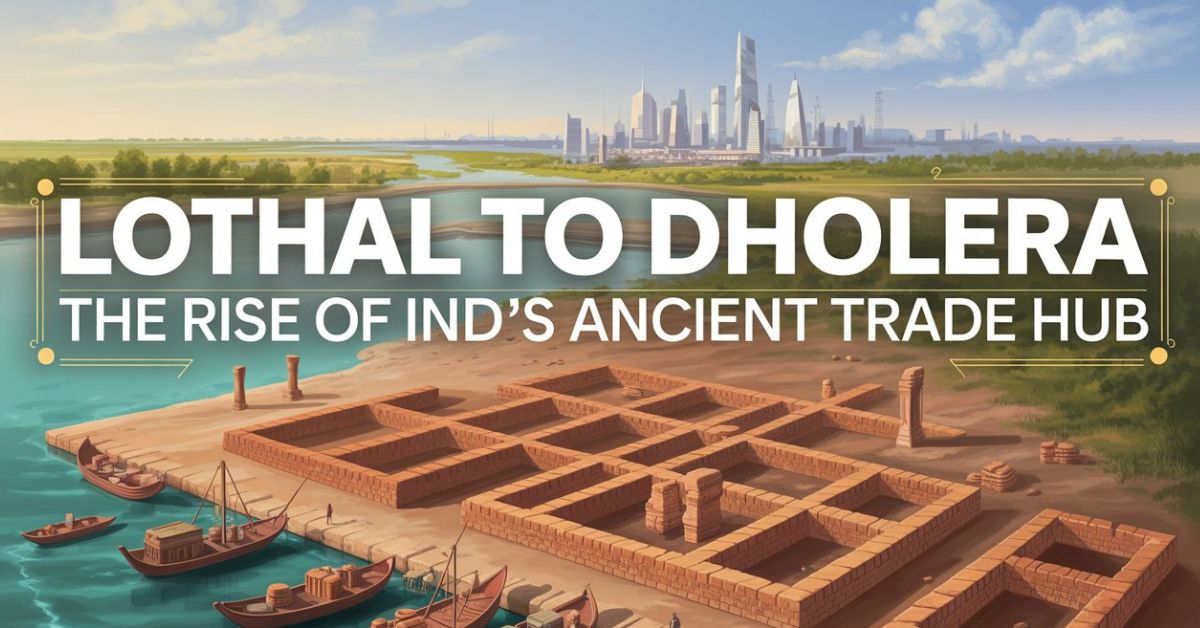
For over 4,500 years, the Bhal region of Gujarat has held a secret in its soil. While the world looks at Dholera SIR as a futuristic “Smart City,” few realize that this land has already been a global superpower once before. As we witness the rise of India’s first greenfield smart city, we are actually seeing the rebirth of an ancient legend: Lothal.
The Legacy of Lothal: Where Global Trade Began
Lothal was not just a city; it was the world’s first perfected trade center. With the earliest known dockyard in human history, the Harappans of Lothal were master engineers who traded beads, gems, and ivory with Mesopotamia and Egypt.
The Bhal region was the “Gateway of India” long before the term existed.
However, as centuries passed, the geography shifted, the waters receded, and the once-vibrant trade hub turned into a landscape of salty dust. For generations, the people of Bhal struggled with the harsh environment, yet they remained the guardians of this historic soil.
The Modern Awakening: From Salt to Semiconductors
Today, history is coming full circle. The very same plains that hosted the Harappan merchants are now preparing to host the world’s most advanced technology.
With the arrival of the Tata Semiconductor Plant and the massive infrastructure of Dholera SIR, the Bhal region is reclaiming its status as a global trade magnet.
The transformation is breathtaking. Where there was once only “Mud,” there is now a “Million” dollar vision. The “Plug-and-Play” infrastructure of modern Dholera is, in many ways, a spiritual successor to the meticulously planned streets and drainage systems of ancient Lothal.
A Local Perspective: The Voice of the Soil
understanding this transition requires more than just looking at government maps; it requires a deep connection to the land. Regional expert and author Shivrajsinh Chudasama, a native of the Bhal region, has spent years documenting this monumental shift.
In his acclaimed book, “THE GOLDEN DUST: Dholera – Mud to Millions,” Chudasama provides an insider’s view of how the struggles of the local farmers and the salinity of the Bhal soil are being transformed into a golden opportunity for global investors.
He argues that Dholera isn’t just a new city; it is the Resurrection of Lothal’s legacy.
Why This Matters for Investors
For an investor, Dholera represents a rare moment in history where ancient strategic geography meets modern 21st-century technology.
By investing in this region, you are not just buying a plot of land; you are becoming part of a 4,000-year-old trade tradition.
As the Delhi-Mumbai Industrial Corridor (DMIC) progresses, the connection between the archaeological marvel of Lothal and the industrial powerhouse of Dholera will create a unique cultural and economic corridor, unmatched anywhere in the world.
Conclusion
The dust of the Bhal region is no longer just salt and sand; it is The Golden Dust. As we move toward 2030, the vision of a “New India” is firmly rooted in the ancient foundations of Lothal. To understand the future of Dholera, one must respect the history of Bhal.