
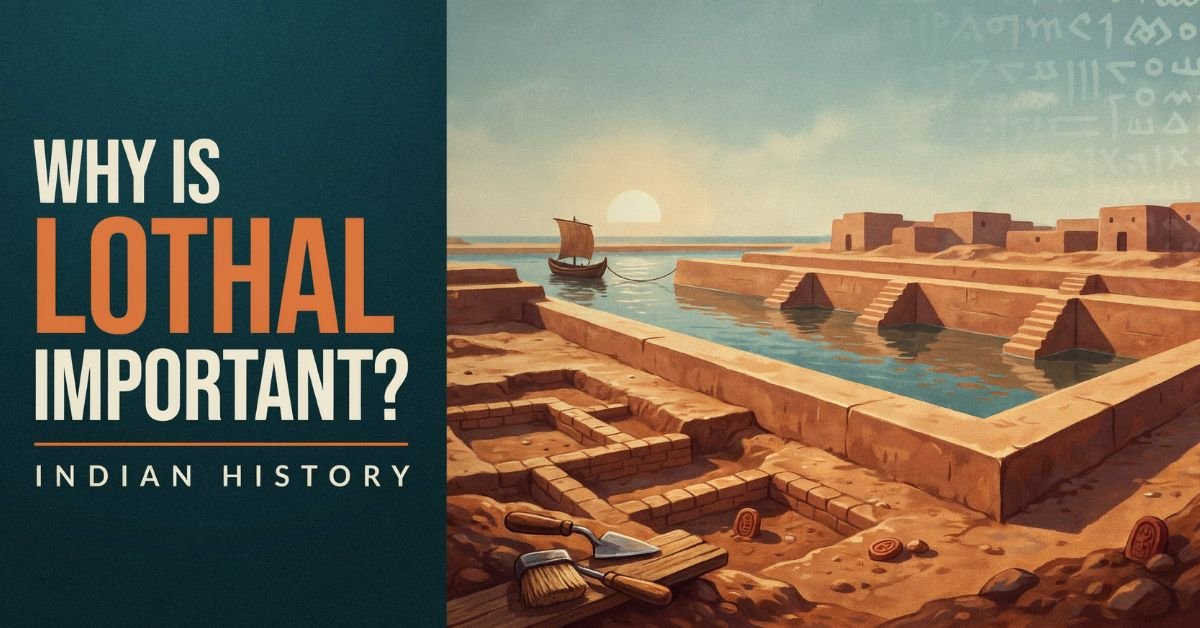
Lothal is one of the most important archaeological sites connected with the Indus Valley Civilization in India. Located in Gujarat, Lothal is famous for its ancient dockyard, planned city, trade network, bead-making industry and evidence of advanced engineering.
The site gives us a valuable look into how people lived, worked, traded and built cities thousands of years ago. Its connection with maritime trade is especially important because it shows that ancient communities in the region were involved in long-distance trade and had strong knowledge of water management and port activities. India’s official tourism portal describes Lothal as an ancient port city with a history spanning more than 4,500 years.
Today, Lothal is becoming even more relevant because of the development of the National Maritime Heritage Complex , which aims to present India’s maritime history to a much wider audience.
Why Is Lothal Important in Indian History?
Lothal is important because it helps us understand the Indus Valley Civilization, ancient Indian trade, maritime history, urban planning, engineering and craft production.
It is not simply a group of old ruins.
Lothal provides physical evidence of a highly organised ancient settlement where people built houses, roads, drainage systems, warehouses and industrial areas.
The site also tells us that ancient Gujarat was connected to wider trade networks.
1. Lothal Was an Important Harappan City
Lothal was part of the Indus Valley Civilization, also known as the Harappan Civilization.
This civilization developed thousands of years ago across parts of present-day India and Pakistan.
Lothal is particularly important because it shows how Harappan culture reached Gujarat and adapted to the local environment.
The remains found at Lothal include residential areas, a citadel, a lower town, drainage systems, a warehouse, craft areas and other structures
What Does Lothal Tell Us About Harappan Life?
Archaeological discoveries at Lothal help researchers understand:
- How people planned their cities
- How houses were built
- How water was managed
- How goods were stored
- How crafts were produced
- How people traded
- How communities lived and worked
This makes Lothal an important source for understanding everyday life during the Harappan period.
2. Lothal’s Ancient Dockyard Is Its Most Famous Feature
One of the biggest reasons Lothal is important in Indian history is its ancient dockyard.
The dockyard is one of the most remarkable structures discovered at the site.
According to India’s official tourism portal, the dockyard measures around 214 metres by 36 metres and included a water-locking system. It is presented as evidence of Lothal’s role as an ancient port connected with maritime activities.
Why Is the Lothal Dockyard Important?
The dockyard gives us clues about the importance of water transport and trade in ancient Gujarat.
It suggests that people living at Lothal understood:
- Water levels
- Tidal conditions
- Boat movement
- Water management
- Port construction
- Maritime trade
This is one reason Lothal has become an important part of India’s maritime history.
3. Lothal Shows the Maritime History of Ancient India
When people think about India’s maritime history, they often think about more recent periods.
But Lothal shows that maritime activity in the Indian subcontinent has very deep roots.
Its location near the Gulf of Khambhat made it suitable for trade and communication through waterways.
The site provides evidence of a community involved in trade and craft production.
Lothal and Ancient Trade
Archaeological discoveries at Lothal include beads, pottery, seals, tools and other objects.
Some materials point towards connections with regions outside the Indian subcontinent. The official tourism portal notes evidence suggesting trade links with West Asian civilizations.
This makes Lothal
4. Lothal Was Known for Bead Making
Lothal was not only a port.
It was also an important centre of craft production.
Archaeologists discovered evidence of a bead-making industry at the site.
Workers used materials such as semi-precious stones to make beads and ornaments.
The discovery of materials including amethyst and onyx provides clues about the skills of ancient craftspeople and the wider trade network connected with Lothal.
Why Is This Important?
It shows that Lothal had different types of economic activity.
There were:
- Traders
- Craftspeople
- Merchants
- Workers
- Farmers
- Administrators
- Other members of the community
This helps us understand that Lothal was a functioning settlement and not simply a small coastal village.
5. Lothal Shows Advanced Urban Planning
Another important reason to study Lothal is its city planning.
The remains show organised construction and public systems.
Researchers have found evidence of:
- Planned streets
- Drainage systems
- Houses
- Wells
- Raised platforms
- Residential areas
- Public structures
The official tourism information about Lothal highlights its engineering and urban-planning achievements.
Ancient Drainage System
The drainage system is particularly interesting.
Thousands of years ago, people were already creating systems to manage wastewater and maintain cleaner living areas.
This is one of the features that makes Harappan cities so important when studying ancient urban development.
6. Lothal Had a Large Warehouse
Archaeological remains at Lothal also include evidence of a large warehouse.
A warehouse would have been important for storing goods before they were transported or traded.
This supports the idea that Lothal was part of an organised economic system.
From Production to Trade
Think of the ancient Lothal economy as a simple chain:
Raw Materials
↓
Craft Production
↓
Storage
↓
Trade
↓
Water Transport
This gives us a better understanding of how an ancient trading city could function.
7. Lothal Helps Us Understand Ancient Gujarat
Lothal is also important because it shows the long history of Gujarat as a place connected with trade and the sea.
Gujarat has a very long coastline and has played an important role in trade throughout history.
Lothal provides an ancient example of this connection.
India’s official tourism portal describes Gujarat as home to Lothal and highlights its importance as a maritime archaeological site.
This gives Lothal a special place in the history of Gujarat.
8. Lothal Connects India With the Ancient World
Trade at Lothal was not limited to the local area.
Archaeological evidence suggests that Lothal was connected with wider trade networks.
This is important because it shows that ancient communities in the region were not isolated.
They were part of a larger world of:
- Trade
- Travel
- Crafts
- Cultural exchange
- Maritime activity
Lothal and West Asian Trade
Objects and materials found at the site have been used to study possible connections between Lothal and regions of West Asia.
This makes Lothal important for understanding early international trade from the Indian subcontinent.
9. Lothal Shows the Skills of Ancient Engineers
The ancient people of Lothal worked with water, bricks, roads, drainage and buildings.
The dockyard is especially important in this regard.
Building and operating such a structure would have required knowledge of the local environment and water movement.
Ancient Engineering at Lothal
Lothal gives us examples of:
- Water management
- Brick construction
- Drainage
- City planning
- Port design
- Storage systems
- Craft production
These discoveries challenge the idea that ancient societies were technologically simple.
10. Lothal Helps Us Understand Daily Life
History is not only about kings and wars.
Archaeological sites like Lothal help us understand ordinary people.
The objects found at Lothal can tell us about:
- What people made
- What they used
- What they traded
- How they lived
- What they ate
- How they travelled
- How they worked
The archaeological museum near the excavation site contains pottery, tools, ornaments, seals and other objects that help explain everyday life during the Harappan period.
11. Lothal Is Important for Understanding Harappan Technology
The Harappan Civilization is known for its strong urban systems.
Lothal adds another important piece to that story.
Its dockyard, drainage system, craft industry and planned settlement show that the people who lived there had practical knowledge of:
Construction + Water + Trade + Manufacturing + Urban Planning
This makes Lothal valuable for students and researchers studying ancient technology.
12.Lothal Is Important for India’s Maritime Heritage
Lothal has a special role in India’s maritime story.
This is also why the development of the National Maritime Heritage Complex at Lothal is significant.
The project aims to showcase India’s long maritime history and create a major visitor destination around this heritage.
This creates a bridge between:
Ancient Maritime History
and
Modern Heritage Tourism
13. NMHC Could Give Lothal’s History a Larger Audience
The National Maritime Heritage Complex (NMHC) Lothal is planned as a major heritage and tourism destination.
The project includes museums, galleries, a recreated Lothal city, a lighthouse museum, hospitality facilities and other visitor attractions.
This could make it easier for people to understand Lothal’s history through modern experiences rather than only viewing archaeological remains.
For Gujarat tourism, this could be an important development.
Why Should Students Learn About Lothal?
Lothal is a great example of how archaeology can change our understanding of history.
Students can learn about:
- Ancient civilizations
- Archaeology
- Geography
- Maritime history
- Engineering
- Trade
- Urban planning
- Ancient technology
- Gujarat’s heritage
Instead of learning history only from books, visiting Lothal allows people to see the remains of an ancient settlement.
Final Thoughts
Lothal is important because it tells a story that goes far beyond one ancient city.
It tells us about the people who lived in Gujarat thousands of years ago.
It tells us about their cities, technology, crafts and trade.
And perhaps most importantly, it shows that the Indian subcontinent had a strong connection with maritime activity and long-distance trade in the ancient past.
Today, Lothal is entering another important chapter through the development of the National Maritime Heritage Complex.
The ancient port may be thousands of years old.
But its story is still being discovered, studied and shared with the world.
Lothal is not just a place from India’s past. It is a window into how advanced and connected ancient Indian societies were.
-
Why is Lothal important in Indian history?
Lothal is important because it provides evidence about the Indus Valley Civilization, ancient maritime trade, urban planning, craft production and engineering in the Indian subcontinent.
-
What is Lothal famous for?
Lothal is especially famous for its ancient dockyard, Harappan city remains, bead-making industry, drainage system and evidence of long-distance trade.
-
Where is Lothal located?
Lothal is located in Gujarat, India, around 90 kilometres from Ahmedabad according to India’s official tourism portal.
-
How old is Lothal?
Lothal is associated with the Harappan/Indus Valley Civilization and has a history going back more than 4,000 years. India’s official tourism portal describes it as a port city with a legacy spanning more than 4,500 years.
-
Why is Lothal called an ancient port city?
Lothal is associated with an ancient dockyard and maritime activity. Its location and archaeological remains provide important evidence for studying ancient water-based trade.
-
Is Lothal part of the Indus Valley Civilization?
Yes. Lothal is an important archaeological site associated with the Harappan or Indus Valley Civilization.